
08\09\2011
Written by Maxi
Fashion Etymology
“Islamic art creates an immediate visual impact. Its strong aesthetic appeal transcends distances in time and space, as well as differences in language, culture, and creed.”
– Dr Linda Komaroff, associate curator of Islamic Art, Los Angeles County Museum of Art.
It is interesting to see the way in which so much of what we see today is inspired from other civilisations without our knowledge. For example, Falconry, an Eastern created tradition, is a sport of the kings still, like horse racing. Falconry was brought from the East by the Huns in AD400, and is still highly regarded by the Sheikhs of the Arab Emirates today. This tying into the modern day by the way of Hermes’ collection based on Falconry, an Eastern etymology. The way in which so many things have evolved is crucial, and luckily luxury brands exploit this.
written by Ben Z. Fern
It was interesting to learn the way in which etymologists have discovered Arabic loan words. These words having been transported from Arabic through other languages such as Greek into the English vocabulary.
Here is an addendum of some textile based, Arabic derived words;
cotton
قطن qutun, cotton. Entered the Romance languages in the mid-12th century and English a century later. Cotton fabric was known to the ancient Romans but it was rare in the Romance-speaking lands until imports from the Arabic-speaking lands in the later medieval era at transformatively lower prices.
damask (textile fabric), damask rose (flower)
دمشق dimashq, Damascus. The city name Damascus is very ancient and not Arabic. The damson plum – earlier called also the damask plum and damascene plum – has a word-history in Latin that goes back to the days when Damascus was part of the Roman empire and so it is not from Arabic. On the other hand, the damask fabric and the damask rose emerged in the Western languages when Damascus was an Arabic-speaking city; and apparently they referred to goods originally resold from or made in Arabic Damascus.
jumper (dress or pullover sweater)
جبّة jubba, a “loose outer garment”. The Arabic entered mid-11th century Italian as jupa meaning “a jacket of oriental origin. Mid 12th century Latin juppum and late 12th century French jupe meant “jacket”. So did the English 14th century ioupe | joupe, 15th century iowpe | jowpe, 17th century jup, juppe, and jump, 18th jupo and jump, 19th jump and jumper.
magazine
مخازن makhāzin (from khazan, to store), storehouses. Used in Latin with that meaning in 1228. Still used that way in French, Italian and Russian. Sometimes used that way in English in the 16th, 17th and 18th centuries, but more commonly in English a magazine was an arsenal, a gunpower store, and later a receptacle for storing bullets. A magazine in the publishing sense of the word started out in English in the 17th century meaning a store of information about military or navigation subjects.
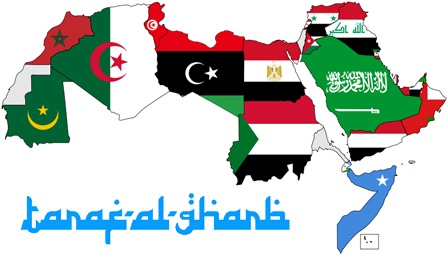
For London though I think there is a place, typically English, that could be seen as a place of beauty. Trafalgar Square is one of London’s most important Arabic Loan words. The home of Nelson’s column and Landseer’s four bronze lions built in the late 1820’s is a symbol of England. However, it’s name is not English at all and has stemmed from Arabic. The square was named after the Battle of Trafalgar in 1805, where the British navy defeated the French and Spanish fleets off the coast of Spain, near cape Trafalgar. The name Trafalgar itself, however, is derived from the Arabic Taraf-al-Gharb, meaning the premonitory of the cave, the edge of the West and a perilous extremity or point.
I think if more people knew the traditional Arabic meaning of the word, they would steer clear, like most Londoners try to and also realize the significance of many of today’s symbols in texts and imagery alike are constantly forgotten.
Ben Z. Fern is our London based intern, studying at Central Saint Martins, with promising potential in journalism, styling and photography.